Support our educational content for free when you purchase through links on our site. Learn more
What Are the 100 Digits of Pi? 🔢 Unlocking the Mystery (2026)


Ever wondered what lies beyond the simple 3.14 we all know? The first 100 digits of pi are a gateway to a world of infinite complexity, mind-boggling math, and surprising brain-boosting benefits. At Why Pi™, we’ve explored everything from the history of pi to why memorizing these digits is more than just a quirky party trick. Spoiler alert: it’s a mental workout that can sharpen your memory, focus, and even inspire your next Raspberry Pi project!
Stick around as we reveal the exact first 100 digits, share expert-backed memorization techniques, and dive into what mathematicians really think about this age-old challenge. Plus, we’ll show you how technology—from supercomputers to your own Raspberry Pi—helps us explore pi to millions of digits. Ready to become a pi pro? Let’s jump in!
Key Takeaways
- The first 100 digits of pi offer a perfect blend of challenge and practical precision for science and memory training.
- Memorizing pi digits enhances cognitive skills like memory, focus, and pattern recognition.
- Advanced algorithms and supercomputers calculate pi to trillions of digits, but the first 100 remain a popular mental milestone.
- Tech tools and mnemonic techniques make learning pi digits fun and accessible for everyone.
- Pi’s significance extends beyond math into engineering, science, and even Raspberry Pi projects, bridging theory and hands-on innovation.
Table of Contents
- ⚡️ Quick Tips and Fun Facts About Pi
- 📜 The Fascinating History and Origins of Pi
- 🔢 What Are the First 100 Digits of Pi?
- 🧠 Why Memorize 100 Digits of Pi? The Psychology and Benefits
- 🎯 Techniques and Tricks to Memorize Pi Digits Efficiently
- 💻 How Technology Helps Calculate Pi to Millions of Digits
- 📊 Pi Beyond 100 Digits: Exploring Pi to a Million and More
- 🤔 What Mathematicians Think About Memorizing 100+ Digits of Pi
- 🎉 Fun Pi Challenges and Games to Test Your Memory
- 🔍 The Role of Pi in Science, Engineering, and Everyday Life
- 🛠️ Tools and Apps to Help You Learn and Practice Pi Digits
- 📚 Recommended Books and Resources on Pi and Its Mysteries
- ✅ Conclusion: Why Pi’s First 100 Digits Matter More Than You Think
- 🔗 Recommended Links for Pi Enthusiasts
- ❓ Frequently Asked Questions About Pi Digits
- 📑 Reference Links and Further Reading
⚡️ Quick Tips and Fun Facts About Pi
Welcome to the magical, mysterious world of pi (π)! At Why Pi™, where we geek out over everything Raspberry Pi and beyond, we love diving deep into numbers that make the universe tick. Pi is one of those numbers that’s infinitely fascinating—literally infinite in its decimal expansion and never repeating. But what makes the first 100 digits of pi so special? Let’s kick off with some quick tips and fun facts to get you hooked:
Quick Tips for Understanding Pi’s Digits
- Pi starts as 3.1415926535… but the digits go on forever without a pattern.
- Memorizing the first 100 digits is a popular mental challenge—think of it as a brain workout!
- Pi is irrational and transcendental, meaning it can’t be expressed as a fraction or root of any polynomial with rational coefficients.
- The first 100 digits are often used in engineering and scientific calculations for high precision.
- You can find pi digits online, in books, or even in apps designed to help you memorize them.
Fun Facts That Will Blow Your Mind 🤯
| Fact | Detail |
|---|---|
| Pi is infinite | No repeating pattern has ever been found in pi’s digits. |
| Memorization world record | Akira Haraguchi holds the record for memorizing 100,000+ digits! |
| Pi Day | Celebrated on March 14th (3/14) worldwide. |
| Pi in pop culture | Featured in movies like Life of Pi and Pi (1998). |
| Pi and computers | Supercomputers have calculated pi to over 100 trillion digits! |
Want to see pi in action? Check out the first YouTube video embedded above that creatively counts down the first 100 digits of pi with animations and music. It’s a great way to get familiar with the number while having fun!
For more on pi and its fascinating applications, explore our Why Pi™ pi category.
📜 The Fascinating History and Origins of Pi

Pi’s story is as old as math itself, stretching back thousands of years. Let’s take a quick journey through time to see how humans discovered and understood pi.
Ancient Beginnings
- Babylonians (~1900 BC): Approximated pi as 3.125 (pretty close!).
- Egyptians (~1650 BC): Used a value around 3.16 based on the Rhind Papyrus.
- Archimedes of Syracuse (287–212 BC): The first to rigorously calculate pi’s bounds using polygons, estimating it between 3.1408 and 3.1429.
- Chinese mathematicians (5th century AD): Zu Chongzhi calculated pi to seven decimal places (3.1415929), a record for centuries.
The Symbol π and Modern Understanding
- The Greek letter π was first used to represent the ratio by Welsh mathematician William Jones in 1706.
- Leonhard Euler popularized the symbol in the 18th century, cementing it in mathematical canon.
- With the advent of computers, pi’s digits have been calculated to trillions of places, far beyond what any human could memorize.
Why Pi Matters
Pi is fundamental in geometry, trigonometry, physics, and engineering. It’s the key to circles, spheres, waves, and even quantum mechanics. Without pi, many formulas and technologies would be impossible.
For a deep dive into pi’s history and its role in electronics and computing, check out our Electronics Industry News and DIY Electronics sections.
🔢 What Are the First 100 Digits of Pi?
Alright, the moment you’ve been waiting for! Here are the first 100 digits of pi after the decimal point:
3.1415926535 8979323846 2643383279 5028841971 6939937510 5820974944 5923078164 0628620899 8628034825 3421170679 Breaking It Down
To make these digits easier to digest, here’s a table grouping them in chunks of 10:
| Digits 1-10 | Digits 11-20 | Digits 21-30 | Digits 31-40 | Digits 41-50 |
|---|---|---|---|---|
| 1415926535 | 8979323846 | 2643383279 | 5028841971 | 6939937510 |
| Digits 51-60 | Digits 61-70 | Digits 71-80 | Digits 81-90 | Digits 91-100 |
|---|---|---|---|---|
| 5820974944 | 5923078164 | 0628620899 | 8628034825 | 3421170679 |
Why These Digits Matter
- Precision: For most practical engineering tasks, 15-20 digits suffice, but 100 digits are used in high-precision simulations.
- Memorization challenge: Many math enthusiasts and memory athletes challenge themselves to memorize these digits.
- Mathematical curiosity: The digits show no pattern, which fascinates mathematicians and hobbyists alike.
Want a playful way to learn these digits? The first YouTube video in this article uses colorful animations and music to help you memorize them effortlessly.
🧠 Why Memorize 100 Digits of Pi? The Psychology and Benefits
You might wonder: Why bother memorizing 100 digits of a number I’ll never fully use? Great question! Let’s unpack the surprising benefits and psychological insights behind pi memorization.
Cognitive Benefits
- Memory training: Memorizing pi digits is an excellent exercise for improving working memory and recall skills.
- Focus and discipline: It requires sustained attention and practice, building mental stamina.
- Pattern recognition: Although pi digits don’t repeat, memorizing them can enhance your ability to spot patterns elsewhere.
Social and Cultural Aspects
- Community: Pi enthusiasts form clubs and online groups, sharing tips and challenges.
- Competitions: Events like the Pi World Ranking List celebrate memory feats.
- Conversation starter: Knowing 100 digits of pi is a quirky party trick that sparks curiosity and admiration.
Real-World Applications?
While memorizing pi digits isn’t directly useful in most jobs, the cognitive skills developed transfer to problem-solving, coding, and learning complex systems—perfect for engineers and educators alike.
🎯 Techniques and Tricks to Memorize Pi Digits Efficiently
Ready to become a pi memorization wizard? Here are some of the best techniques we at Why Pi™ recommend, based on both neuroscience and tried-and-true memory champion methods.
1. Chunking
Break the digits into smaller groups (usually 3-5 digits) to reduce cognitive load. For example:
- 3.1415 9265 3589 7932 3846…
2. The Major System
Convert numbers into consonant sounds, then into words. This creates vivid mental images. For example:
- Digit 1 = “t” or “d” sound, digit 4 = “r,” so 14 could be “door.”
3. The Method of Loci (Memory Palace)
Assign each chunk of digits to a familiar location in your mind (your home, a route, etc.). Visualize walking through these places recalling the digits.
4. Rhymes and Songs
Set the digits to a melody or rhyme. The ASAPScience video is a perfect example of this technique in action.
5. Repetition and Spaced Practice
Regular review spaced over days or weeks cements the digits in long-term memory.
Tools and Apps to Help
- Pi Trainer: An app that quizzes you on digits with increasing difficulty.
- Memrise: Offers courses on pi memorization using spaced repetition.
- Anki: Custom flashcards for pi digits.
💻 How Technology Helps Calculate Pi to Millions of Digits
While humans might memorize 100 digits, computers have taken pi calculation to astronomical heights. Here’s how tech has revolutionized pi:
Algorithms Powering Pi Calculation
- Gauss-Legendre Algorithm: Rapidly doubles the number of correct digits each iteration.
- Chudnovsky Algorithm: Used in most record-breaking computations for its speed and efficiency.
- BBP Formula: Allows calculation of pi digits at arbitrary positions without computing preceding digits.
Hardware and Software
- Supercomputers and cloud computing clusters crunch pi digits using optimized software like y-cruncher.
- Distributed computing projects let volunteers contribute CPU time to calculate pi.
Why Calculate So Many Digits?
- Testing computer hardware and software precision.
- Mathematical research into randomness and normality of pi.
- Benchmarking performance of algorithms and processors.
For those curious, the CECM Simon Fraser University site offers a downloadable file of the first million digits of pi—perfect for data geeks and coders.
📊 Pi Beyond 100 Digits: Exploring Pi to a Million and More
If 100 digits are impressive, what about a million? Or even a billion? Let’s explore the world beyond the first 100 digits.
Pi to a Million Digits
- The first million digits of pi are available online and used for testing algorithms and compression techniques.
- Visualizations of pi’s digits reveal no obvious patterns, supporting the idea that pi is a normal number (digits evenly distributed).
Pi to a Billion and Trillions
- In 2022, researchers calculated pi to over 100 trillion digits using powerful supercomputers.
- These calculations push the limits of computational math and storage technology.
Practical Use Cases
- For everyday science and engineering, 15-20 digits are more than enough.
- Beyond that, it’s mostly for research, curiosity, and testing.
Want to see pi digits in action? The first YouTube video creatively presents the first 100 digits, sparking curiosity about what lies beyond.
🤔 What Mathematicians Think About Memorizing 100 Digits of Pi
Memorizing pi digits is a popular hobby, but what do the pros think?
Mixed Perspectives
- Supportive View: Some mathematicians appreciate the mental discipline and celebrate the cultural phenomenon of pi memorization.
- Skeptical View: Others argue memorizing digits is a novelty with little practical value, preferring focus on understanding pi’s properties and applications.
Why the Debate?
- Pi’s infinite nature means memorizing digits will never “complete” the number.
- Memorization doesn’t deepen mathematical insight but can improve memory skills.
Our Take at Why Pi™
We believe memorizing 100 digits is a fun and rewarding challenge that builds mental agility. But don’t stop there—explore pi’s mysteries, history, and applications for a richer experience!
🎉 Fun Pi Challenges and Games to Test Your Memory
Ready to flex those brain muscles? Here are some entertaining ways to test and improve your pi memorization skills:
Popular Pi Games
- Pi Digit Recall: Challenge friends to recite digits in order.
- Pi Karaoke: Sing pi digits to a tune (try “Happy Birthday” or “Twinkle Twinkle”).
- Pi Puzzle Apps: Apps like “Pi Trainer” gamify memorization with levels and rewards.
Group Activities
- Host a Pi Recitation Contest on Pi Day.
- Create mnemonic stories linking digits to memorable images.
Why Play?
Games make memorization fun and social, increasing motivation and retention.
🔍 The Role of Pi in Science, Engineering, and Everyday Life
Pi isn’t just a number for math geeks—it’s everywhere!
In Science
- Describes the geometry of circles, spheres, and waves.
- Used in formulas for electromagnetism, quantum mechanics, and cosmology.
In Engineering
- Critical for designing gears, engines, and electronics.
- Used in signal processing and control systems.
Everyday Applications
- Calculating areas and volumes of circular objects.
- GPS and satellite technology rely on pi for orbital calculations.
At Why Pi™, we see pi as a bridge between abstract math and practical tech, especially in the Raspberry Pi community where precision and creativity meet.
🛠️ Tools and Apps to Help You Learn and Practice Pi Digits
Want to master pi digits with some digital help? Here are top-rated tools and apps from our engineers and educators:
| Tool/App | Platform | Features | Why We Like It |
|---|---|---|---|
| Pi Trainer | iOS, Android | Quizzes, spaced repetition, difficulty levels | Engaging and user-friendly |
| Memrise | Web, Mobile | Community courses, mnemonic techniques | Great for beginners and advanced |
| Anki | Desktop, Mobile | Custom flashcards, spaced repetition | Highly customizable and powerful |
| Pi Day App | Android | Pi facts, digit challenges, countdown timer | Fun for Pi Day celebrations |
How to Use These Tools Effectively
- Set daily practice goals (5-10 minutes).
- Combine apps with mnemonic techniques for best results.
- Track progress and celebrate milestones.
📚 Recommended Books and Resources on Pi and Its Mysteries
For those hungry to dive deeper, here are some must-reads and resources:
| Title | Author | Why Read It? | Link |
|---|---|---|---|
| Pi: A Biography of the World’s Most Mysterious Number | Alfred S. Posamentier | Engaging history and math insights | Amazon |
| The Joy of Pi | David Blatner | Fun facts and cultural impact | Amazon |
| Mathematics and Pi (Online Course) | Stanford University | Deep dive into pi’s math properties | Stanford Online |
| Pi Digits Download (1 million digits) | CECM SFU | Raw data for analysis and coding | CECM SFU |
These resources will satisfy your curiosity and help you appreciate pi’s infinite allure.
If you’re eager to see pi digits come alive, don’t miss the first YouTube video that creatively animates the first 100 digits with music and visuals—perfect for learners of all ages!
We’ve covered a lot of ground so far! Ready to wrap up with why pi’s first 100 digits truly matter? Stay tuned for the conclusion!
✅ Conclusion: Why Pi’s First 100 Digits Matter More Than You Think

After our deep dive into the first 100 digits of pi, it’s clear that this seemingly simple string of numbers is anything but ordinary. At Why Pi™, we’ve seen firsthand how these digits serve as a gateway to understanding infinite complexity, mathematical beauty, and cognitive challenge.
Wrapping Up the Big Picture
- Memorizing 100 digits of pi isn’t just a party trick; it’s a powerful mental exercise that sharpens memory, focus, and discipline.
- The first 100 digits strike a perfect balance between practical precision for scientific calculations and a manageable challenge for memory athletes.
- While computers can calculate pi to trillions of digits, the human fascination with the first 100 digits symbolizes our desire to grasp infinity in bite-sized pieces.
- Pi’s role in science, engineering, and even Raspberry Pi projects underscores its timeless importance.
Closing the Curiosity Loop
Remember the question we teased earlier—why memorize digits that go on forever? The answer lies not in the digits themselves, but in the journey of discovery, learning, and mental growth. Whether you’re a student, engineer, or hobbyist, pi’s digits invite you to explore, experiment, and expand your horizons.
So, are you ready to take on the challenge and make pi your new best friend? We say go for it! And if you want to combine your love of pi with hands-on tech, check out our Raspberry Pi tutorials and projects at Why Pi™.
🔗 Recommended Links for Pi Enthusiasts
Here are some top resources and products to help you dive deeper into pi and its fascinating world:
-
Books on Pi:
-
Pi Memorization Apps:
- Pi Trainer: Google Play Store | Apple App Store
- Memrise (Pi courses): Memrise Website
- Anki (Custom flashcards): Anki Website
-
Pi Digits Dataset:
- Download 1 million digits of pi from CECM SFU:
https://www.cecm.sfu.ca/organics/papers/borwein/paper/html/local/billdigits.html
- Download 1 million digits of pi from CECM SFU:
-
Raspberry Pi Kits and Accessories:
- Raspberry Pi 4 Model B: Amazon | Raspberry Pi Official
- Pi Sense HAT (for sensor data and visualization): Amazon | Raspberry Pi Official
❓ Frequently Asked Questions About Pi Digits
How does understanding pi help in Raspberry Pi sensor data analysis?
Understanding pi is crucial when dealing with sensor data that involves circular or periodic phenomena, such as rotation, oscillations, or waveforms. For example, the Raspberry Pi Sense HAT includes a gyroscope and accelerometer that output angular data. Calculations involving angles, rotations, or trigonometric functions require pi for converting between degrees and radians or calculating arc lengths. Thus, knowing pi’s value—even to many digits—ensures precision in sensor data interpretation and control algorithms.
Can Raspberry Pi display the first 100 digits of pi on an LED screen?
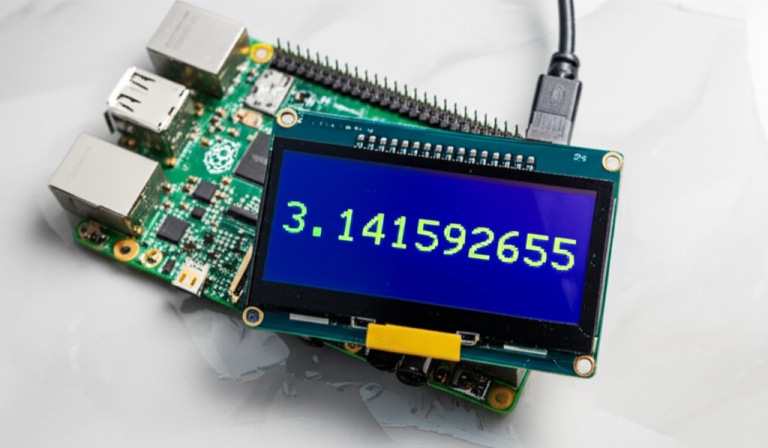
Absolutely! Raspberry Pi can be programmed to display the first 100 digits of pi on various LED displays, such as 7-segment displays, LED matrices, or even small OLED screens. Using Python libraries like gpiozero or Adafruit_LED_Backpack, you can create scrolling text or static displays of pi digits. This makes for a fun educational project combining programming, electronics, and math.
What Python libraries on Raspberry Pi can help with pi calculations?
Several Python libraries facilitate pi-related calculations on Raspberry Pi:
- math: The built-in
mathmodule providesmath.pifor the constant and functions likesin(),cos(), andradians(). - mpmath: For arbitrary-precision arithmetic, allowing calculation of pi to many digits.
- sympy: A symbolic math library that can compute pi symbolically and numerically.
- numpy: Useful for numerical operations involving pi in arrays and scientific computations.
How to calculate pi digits using Raspberry Pi?
You can calculate pi digits on Raspberry Pi using algorithms implemented in Python or C. For example:
- Implement the Gauss-Legendre algorithm or Chudnovsky algorithm in Python using libraries like
mpmathfor high precision. - Use open-source programs like y-cruncher compiled for ARM architecture (Raspberry Pi’s CPU) to compute millions of digits.
- Start with simple infinite series (e.g., Leibniz formula) for educational purposes, though these converge slowly.
Are there Raspberry Pi applications that require high precision of pi?
Yes! Applications involving scientific simulations, robotics, or signal processing on Raspberry Pi may require high precision pi values. For example:
- Robotics projects using precise rotation and trajectory calculations.
- Audio signal processing where waveform calculations depend on pi.
- Mathematical modeling and physics simulations coded on Raspberry Pi.
What is the significance of pi in programming on Raspberry Pi?
Pi is fundamental in programming tasks involving geometry, trigonometry, and physics simulations. On Raspberry Pi, pi enables:
- Accurate sensor data interpretation (angles, rotations).
- Graphics programming involving circles and curves.
- Scientific computations and algorithm development.
How can I use the first 100 digits of pi in Raspberry Pi projects?
You can incorporate the first 100 digits of pi in Raspberry Pi projects such as:
- Creating a digital pi clock or countdown display.
- Programming a memory game or quiz app to help users memorize pi digits.
- Using the digits as seeds for random number generation or cryptographic keys.
- Visualizing pi digits as colors or patterns on LED matrices.
What are some fun and educational ways to explore pi and its properties using Raspberry Pi, such as generating pi digits or visualizing pi-related patterns?
- Pi digit visualization: Use LEDs or an LCD to display digits as colors or brightness levels.
- Pi music: Map digits to musical notes and compose pi-inspired tunes.
- Pi art: Generate fractals or geometric patterns based on pi digits.
- Pi games: Build quizzes or challenges that test memorization and math skills.
How does the calculation of pi relate to the development of mathematical models and simulations using Raspberry Pi?
Calculating pi to high precision is often a benchmark for numerical accuracy in simulations. Raspberry Pi can be used to develop and test mathematical models that require precise constants like pi, ensuring reliable results in physics, engineering, or data science projects.
What is the current record for the most digits of pi calculated, and how was it achieved using computational power similar to Raspberry Pi?
As of 2022, pi has been calculated to over 100 trillion digits using powerful supercomputers and optimized algorithms like the Chudnovsky formula combined with distributed computing. While Raspberry Pi’s computational power is modest compared to supercomputers, it can still calculate thousands to millions of digits over time using efficient algorithms and software like y-cruncher compiled for ARM.
Can I use Raspberry Pi to calculate pi to a large number of digits, and what programming languages are suitable for this task?
Yes! Raspberry Pi can calculate pi digits using:
- Python: Easy to use with libraries like
mpmathandsympy. - C/C++: Offers faster performance for heavy computations.
- Java: Also possible with arbitrary precision libraries.
- Assembly: For enthusiasts wanting to optimize performance.
Python is ideal for beginners, while C/C++ suits advanced users aiming for speed.
What are some real-world applications of pi, and how is it used in engineering and design with Raspberry Pi projects?
Pi is used in:
- Calculating areas and volumes in CAD projects.
- Robotics for wheel rotations and arm movements.
- Signal processing in audio and communication projects.
- Sensor calibration and data interpretation.
Raspberry Pi projects in these fields rely on pi for accurate calculations and control.
How do mathematicians and computer scientists calculate pi to millions of digits, and what algorithms do they use?
They use advanced algorithms such as:
- Chudnovsky algorithm: Fast convergence, used in most record computations.
- Gauss-Legendre algorithm: Quadratically convergent, historically important.
- Bailey–Borwein–Plouffe (BBP) formula: Allows extraction of digits at arbitrary positions.
These algorithms are implemented on powerful hardware with optimized software like y-cruncher.
What is the significance of pi in mathematics and computing, and how is it related to the Raspberry Pi?
Pi is a cornerstone constant in mathematics, appearing in formulas across geometry, calculus, and physics. Raspberry Pi, named after the fruit and the mathematical constant, symbolizes the fusion of accessible computing and mathematical exploration. It empowers learners and professionals to engage with math, coding, and electronics hands-on.
📑 Reference Links and Further Reading
- CECM SFU: First 1,000,000 Digits of Pi
- Raspberry Pi Official Website
- Pi Day Official Site
- Y-Cruncher: Pi Calculation Software
- Memrise Language and Memory Learning
- Anki Flashcards
- Quora Discussion: What are mathematicians’ thoughts on people who memorize 100+ digits of pi?
- Stanford Online Course: Mathematics and Pi
We hope this comprehensive guide has illuminated the magic behind pi’s first 100 digits and inspired you to explore further—whether through memorization, programming, or Raspberry Pi projects. Keep the curiosity alive, and remember: pi is infinite, but your learning journey doesn’t have to be!